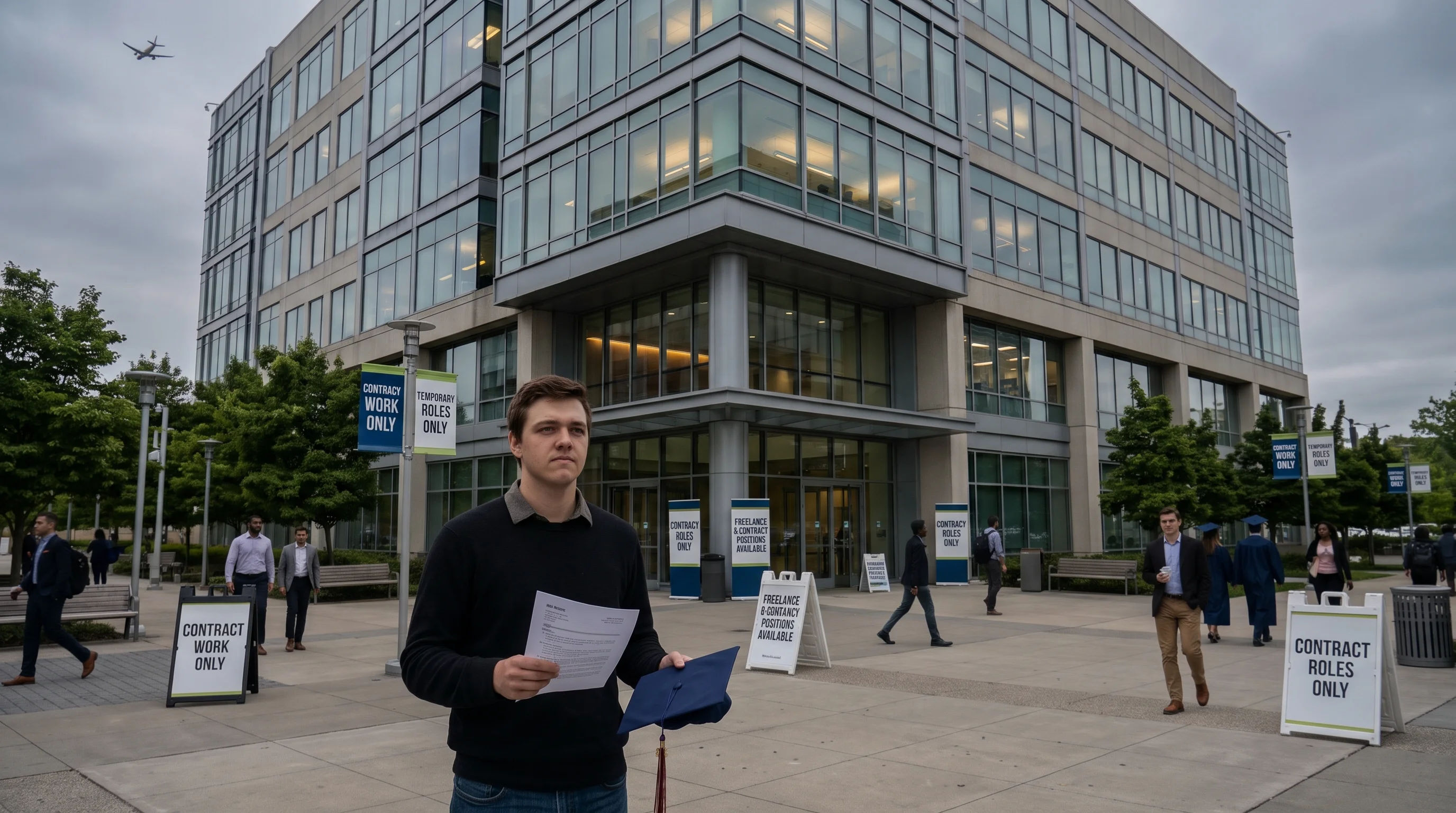
You can do everything right, keep your GPA up, land an internship, and fire off 80 applications over the summer, only to hear back from two recruiters. It's a frustrating spot to be in, and right now the timing is working against a lot of graduates. Entry-level jobs have gotten hard to find, even though the economy as a whole is still adding work.
According to the Federal Reserve Bank of New York's , about 5.6% of graduates aged 22 to 27 were unemployed in mid-2026. That figure looks manageable, but more than 4 in 10 recent graduates held jobs that didn't require their degree.
The Underemployment Trap
A degree still lowers your risk of unemployment. Peers aged 22 to 27 without one had a 7.2% unemployment rate in early 2026, compared with roughly 5.6% for graduates.
The bigger issue is underemployment: holding a degree while working a job that doesn't require one. In practice, it looks like:
A biology graduate working as a pharmacy tech while applying for lab roles
A business graduate answering phones at a front desk, hoping for a promotion
Both earn a paycheck, yet the work does little to develop the skills their degrees were supposed to lead to.
The figures below add context.
Labor Market Indicator | Latest Figure | Source |
|---|---|---|
Recent graduate unemployment (ages 22 to 27) | About 5.6%Q2 2026 | Federal Reserve Bank of New York |
Recent graduates in jobs that don't require a degree | 42%Q2 2026 | Federal Reserve Bank of New York |
Unemployment for peers without a four-year degree (ages 22 to 27) | 7.2%Q1 2026 | Federal Reserve Bank of New York |
Monthly hires as a share of all jobs | 3.4%June 2026 | U.S. Bureau of Labor Statistics |
Jobs added nationwide | 29,000September 2026 | U.S. Bureau of Labor Statistics |
Employment of 22 to 25 year olds in the most AI-exposed roles | Down about 11%Nov 2022 to June 2026 | Stanford Digital Economy Lab |
When People Stop Quitting, New Grads Get Stuck
Economists describe today's market as "low-hire, low-fire." Layoffs remain low, and companies have also pulled back sharply on adding staff.
The U.S. Bureau of Labor Statistics' shows employers hired about 3.4% of the workforce in June 2026, while only 2% of workers quit and 1.1% were laid off. Researchers at the Federal Reserve Bank of Richmond found this is rare by historical standards.
How One Resignation Opens a Door for You
Most entry-level openings are created indirectly. When a mid-level employee quits, the company often promotes someone junior, and the junior seat opens for a new hire. When quits fall to historic lows, that chain stops moving and the bottom rung never empties.
Tariffs, energy costs, and uncertainty about AI also make new hires feel like a risky bet. Meanwhile, laid-off workers with experience compete for the same junior roles graduates want.
Finance and Tech Are Raising the Bar for Junior Roles
According to the U.S. Bureau of Labor Statistics, finance has lost 129,000 jobs since May 2025, mostly at insurance companies. Government and information jobs, which include much of tech and media, also declined in 2026.
The postings that remain ask for more. PwC's 2026 Global AI Jobs Barometer found that in the occupations most exposed to AI, about half the new skills in entry-level postings used to be required only of experienced workers.
A junior analyst posting that asks for three years of experience and advanced SQL is an associate role in salary and title only.
AI Is Taking Over the Apprenticeship Layer of White-Collar Work
The Stanford Digital Economy Lab's August 2026 update to found that employment for 22 to 25 year olds in the most AI-exposed roles fell about 11% since late 2022, while older workers in those roles held steady or grew.
The pattern follows the work itself. Entry-level roles often center on procedural tasks and routine baseline work, such as drafting first versions or answering standard questions. AI now handles a large share of that work, while judgment built through years on the job remains much harder to automate. In customer support, chatbots now resolve many simple tickets that once trained new hires, while complex cases still go to senior staff.
The Stanford researchers note that rate hikes and post-pandemic overhiring also cut into junior hiring.
Working From Home Made You Harder to Train
The Federal Reserve Bank of New York's June 2026 found that remote work could explain nearly two-thirds of the recent rise in unemployment for young college graduates.
Junior workers who sit near teammates get more feedback and mentoring. The company studied kept hiring young workers when it could train them in person, and hired fewer when distance made that harder.
For you, a hybrid or in-office role may offer faster skill growth in year one than a fully remote job with slightly higher pay.
AI Investment Is Lifting GDP Faster Than Payrolls
Economists at ING estimate that AI spending accounts for about a third of U.S. growth this year, according to . Over the same stretch, most other business investment shrank for six straight quarters through early 2026.
Data centers need chips, power infrastructure, and construction crews, but they create few openings for junior analysts or marketing coordinators. The U.S. Bureau of Labor Statistics reported in its that employers added just 29,000 jobs, with gains for the two prior months revised down.
Health Care Is Carrying Much of the Hiring
The Federal Reserve Bank of Atlanta's latest shows health care added roughly 29,000 jobs a month through September 2026, about 4 in every 10 new jobs nationwide. September's BLS report also showed gains in construction and manufacturing.
Many roles in these sectors fit a general degree:
Health data or billing analyst
Patient services or operations coordinator
Project coordinator at a construction firm
An economics major uses the same spreadsheet skills in a hospital billing department that a bank would want. Right now, hospital systems are adding those roles at a steadier pace.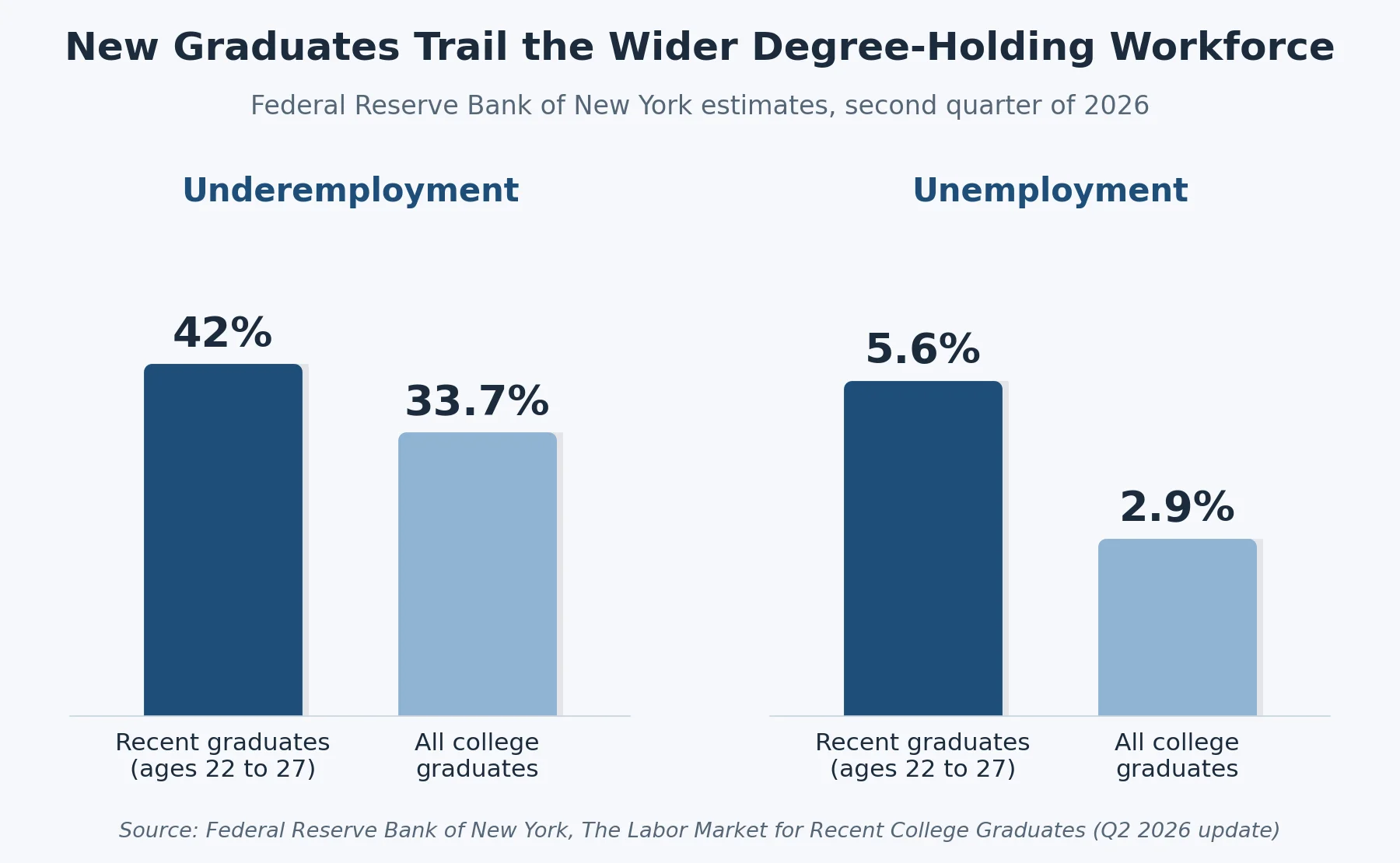
Side Gigs Cover the Bills, but Provide No Promotional Path or Employer Benefits
According to The Harris Poll, 57% of Gen Z have a side gig, compared with 21% of boomers and older, as reported in coverage of . Reddit career forums echo that frustration, with frequent complaints about ghosting and entry-level postings that demand years of experience.
Gig income usually arrives without employer health insurance, a retirement match, or a predictable monthly amount, and self-employment taxes come out of what you earn.
It helps your career when it produces evidence. A freelance designer with a portfolio of 12 client projects can show employers exactly what she delivers.
Why Your First Job Is Hard to Shake
New York Fed data shows how far behind new graduates start. In the second quarter of 2026, 42% of recent graduates worked in jobs that didn't need their degree, compared with about a third of all college graduates. Their unemployment rate was nearly double.
The gap narrows with time as many graduates move into degree-level roles. Still, roughly one in three degree holders of every age works below their training, so a sizable share doesn't make that jump.
Today's market makes the first move harder. A 2026 analysis from the Burning Glass Institute, reported in coverage of the , found the unemployment gap between young graduates and peers without degrees is the smallest in roughly 30 years. Employers have grown more reluctant to take a chance on inexperienced hires.
Get Real Experience Before You Graduate
Internships remain one of the strongest protections against a slow start, because they show employers you can handle real work.
Fixing the gap isn't only on you. Colleges can make paid internships and co-op programs a standard part of earning a degree, and employers can set aside time to train new hires in person.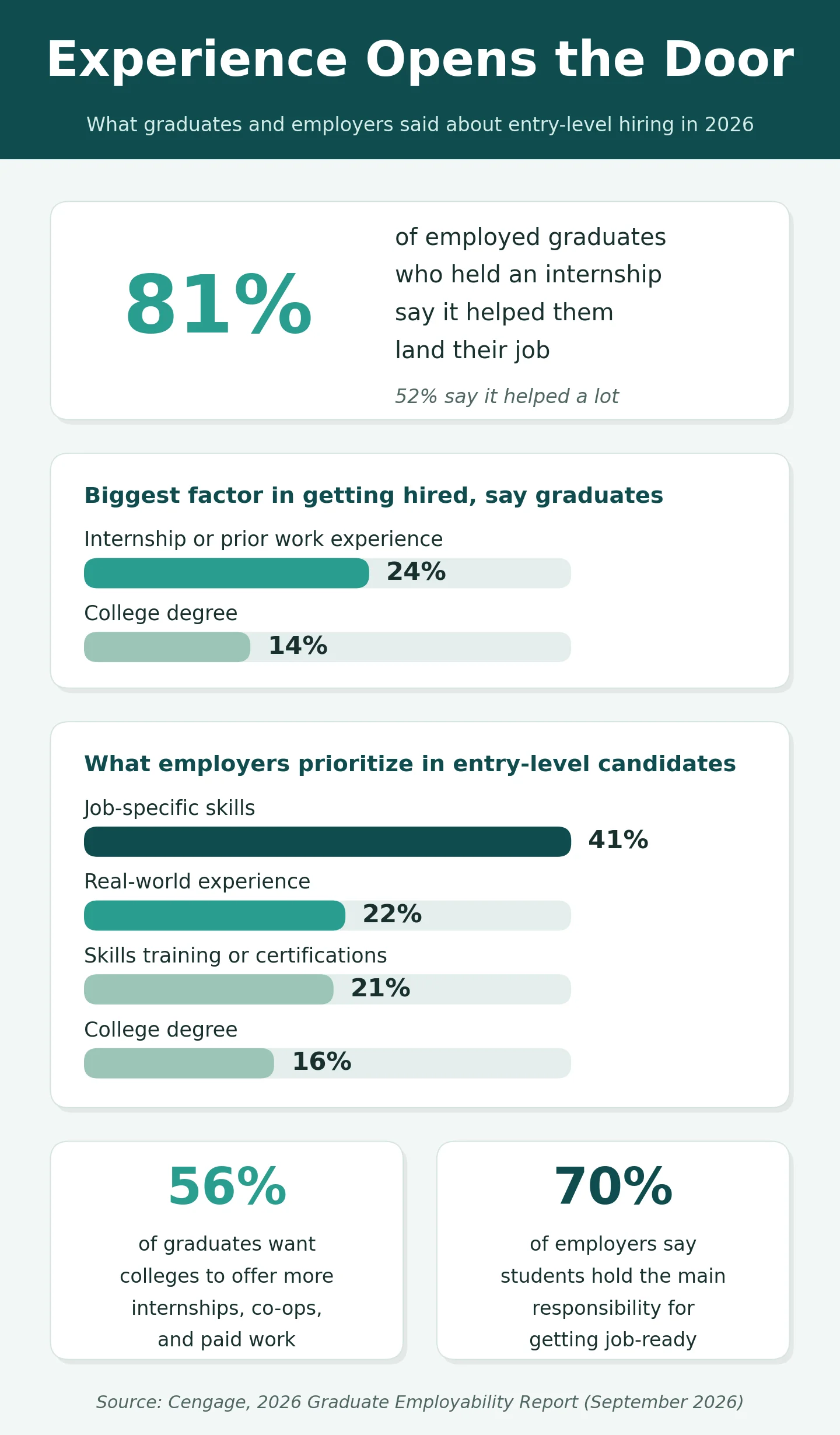
Starting early pays off. A paid summer internship after sophomore year means you walk into senior-year recruiting with a professional reference, plus a real project to talk through in interviews.
Play the Market You Have
Hiring at the entry level has slowed considerably, though openings still exist for graduates who adjust where they look. Focus on sectors that are hiring, choose roles where someone will train you, and treat every internship or gig as proof of what you can do.
 Can 3-Year Degrees Solve the Teacher Shortage?
 Does College Public Speaking Really Matter in Today’s Job Market?
 Strategies for Communicating Tuition and Outcomes to Prospective Students
 How Politics Is Shaping College Enrollment
 How Top Performers Land US Job Offers