
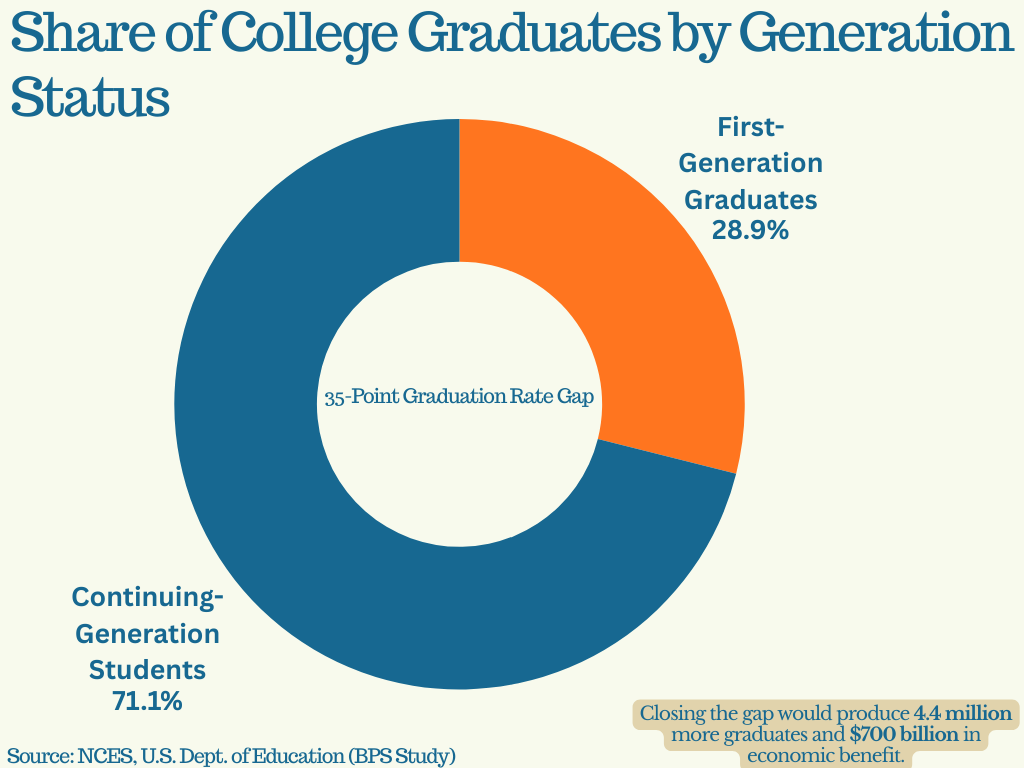
First-generation college students now make up over half of all U.S. undergraduates. The reports 8.2 million first-gen undergraduates enrolled today, roughly 54% of the total. Their graduation rates tell a different story: 24%, compared to 59% for continuing-generation students. Closing this gap would produce an estimated 4.4 million additional graduates and a $700 billion net benefit to the U.S. economy, according to . For university leadership, that points to both a moral obligation and a strategic one. First-gen programs that work share common traits: structured mentorship, targeted academic support, financial literacy, institutional belonging, and family engagement.
The Completion Gap
The statistics on first-generation college students are consistent across data sources. Research published in found that only about 27% of first-gen students complete a bachelor's degree within four years, compared to 42% of continuing-generation peers. A 2025 found first-gen students are twice as likely to leave without a degree, even when controlling for income and academic preparation.
shows these students are disproportionately Hispanic, Black, and Native American. They are more likely to be older, work while enrolled, have dependents, and attend public institutions. EAB research shows 33% drop out within three years, compared to 14% of continuing-generation students.
The causes are well documented: lower academic preparedness from under-resourced high schools, limited familiarity with college systems and terminology, financial strain, and a persistent sense of not belonging. First-gen students use health services, academic advising, and academic support at lower rates than their peers. The services often exist. The problem is access, awareness, and comfort.
Mentorship and Networking
Connecting with mentors who share a first-gen background is one of the most effective interventions. An Ithaka S+R evaluation of the found that 83% of first-year participants were assigned a peer mentor. Of those, 74% actively engaged throughout the year, 83% discussed academic topics, and 70% reported a better understanding of campus resources.
Students said the most helpful part was having someone who had recently been through the same transition. That kind of credibility is hard to replicate through staff advising alone.
Institutions are responding. The University of Wisconsin-Madison, UNC Charlotte, and Syracuse University's Whitman School of Management have all launched first-gen mentorship programs tied to rising enrollment. Syracuse saw first-gen enrollment jump from 12% to 19% between fall 2022 and fall 2023.
Pre-college pipeline programs also show results. Code2College, which serves underrepresented high school students through STEM education and paid internships, reported a 96% college matriculation rate for its Class of 2024, with over 80% choosing STEM majors.
Targeted Academic Support
The largest federal investment in first-gen retention is TRIO Student Support Services (SSS), funded under the Higher Education Act of 1965. The requires all SSS programs to provide academic tutoring, course advising, and financial aid guidance.
A rigorous 2019 evaluation found SSS participants at four-year institutions were 18% more likely to earn a bachelor's degree than comparable non-participants. At two-year institutions, that figure rises to 48%. The Council for Opportunity in Education reports SSS participants outperformed peers in degree completion at both two-year colleges (41% vs. 28%) and four-year colleges (48% vs. 40%).
First-year seminars add another layer. Controlled studies show they increase second-year retention by 7 to 13 percentage points across all demographic groups. Summer bridge programs build college knowledge and academic confidence before classes begin.
The common thread is structure. First-gen students benefit most when academic support is built into their experience rather than offered as an opt-in. Mandatory advising check-ins, embedded tutoring within courses, and early-alert systems that flag disengagement outperform models that wait for students to seek help.
Financial Literacy and Aid
Financial stress is the most consistent barrier to first-gen completion. Research published in the College Student Affairs Journal found that first-gen students scored higher on financial strain measures and lower on financial knowledge, self-efficacy, and optimism than peers, based on data from the .
The knowledge gap starts early. A study published in Metropolitan Universities found 44% of high school juniors did not know what the FAFSA was. First-gen students showed even lower awareness of financial aid terminology and processes. Nearly 70% of first-gen students in the 2011-12 cohort received Pell Grants, per NCES data.
, published in the American Journal of Sociology, found that need-based grant aid boosts year-to-year retention and degree completion by roughly 1.5 to 3 percentage points. That effect is strongest for first-gen and low-income students.
What institutions should do: run budgeting workshops in the first semester, create emergency grant funds, offer one-on-one financial coaching, and write financial aid award letters in plain language. Confusing award letters compound the problem for students whose families have no experience interpreting them.
Institutional Belonging
Lack of belonging is one of the primary reasons first-gen students leave college. A systematic review published in found that first-gen students who dropped out frequently cited feeling like they did not fit in. These students are less likely than their peers to join clubs, recreational sports, sororities, fraternities, and other campus social groups.
First-gen-specific communities address this directly. Kessler Scholars Program respondents reported learning about campus resources (90%), connecting with other scholars (89%), and gaining confidence (77%). Over 470 institutions now belong to the , committing to treat first-gen identity as an institutional priority.
Recognizing first-gen status in campus communications, orientation materials, and advising interactions signals to students that they are seen. This matters because the "hidden curriculum" of college鈥攗nwritten rules about office hours, email etiquette, networking, and self-advocacy鈥攊s invisible to students who cannot learn it at home. notes that first-gen students often lack familiarity with these expectations not because of ability, but because no one has taught them the norms.
Family Support and Understanding
Family encouragement is one of the strongest predictors of first-gen enrollment and persistence. A systematic review by found that family support shapes outcomes at every stage. But first-gen parents face a knowledge gap. They want to help and often lack familiarity with academic expectations, registration systems, and financial aid processes.
Many first-gen students also carry "achievement guilt," a discomfort with opportunities their families do not have access to. Research links this to depressive symptoms and lower self-esteem. Students may also carry caregiving responsibilities鈥攄riving parents to appointments, babysitting siblings, contributing financially鈥攖hat reduce time for coursework.
recommends engaging parents starting in the admissions process. Family orientation programs, parent communications in accessible language, and family weekends that demystify college all help. Framing the student's education as a family achievement rather than a departure from the family reduces guilt and strengthens the support system.
Beyond the Bachelor's Degree
The completion gap does not end at graduation. The found that first-gen graduates earn a median household income of $99,600, compared to $135,800 for those with college-educated parents. Students from higher socioeconomic backgrounds pursue advanced degrees at higher rates, leaving first-gen alumni behind in long-term career outcomes.
The Ronald E. McNair Post-Baccalaureate Achievement Program, a federal TRIO initiative, prepares first-gen and underrepresented students for doctoral study through research mentoring and graduate school preparation. Institutions should build these pipelines during the undergraduate years through research assistantships, faculty mentoring on graduate applications, and GRE preparation.
First-gen graduate students face many of the same belonging and financial challenges as undergrads, often without equivalent programming. Institutions that track and support first-gen identity beyond the bachelor's degree retain more students in advanced programs.
What to Prioritize
For university leadership, the evidence points to a clear set of priorities:
Identify first-gen students early. Standardize definitions and tracking so you know who you are serving.
Protect and expand TRIO SSS. Decades of evidence support it. Treat it as core infrastructure.
Integrate support services. Academic advising, financial coaching, mentorship, and belonging programming should connect through a coordinated model, not isolated offices.
Train faculty and staff. Cultural competency around class, family obligation, and hidden curriculum gaps should be standard professional development.
Measure first-gen outcomes separately. Retention, graduation, and post-graduation data for first-gen students should drive programming decisions.
With first-gen students representing over half of all undergraduates, their success is the institution's success. The interventions that work are not mysterious. They require commitment, coordination, and sustained investment.
 How International Students Can Build Successful U.S. Companies on F-1 and OPT Visas
 Are Extension Schools Worth It? Pros, Cons, and Costs
 Do College Career Development Programs Help Students Get Jobs?
 How Universities Can Improve Student Engagement and Retention
 College Survival Guide: What to Do Before You Arrive and Every Year After